


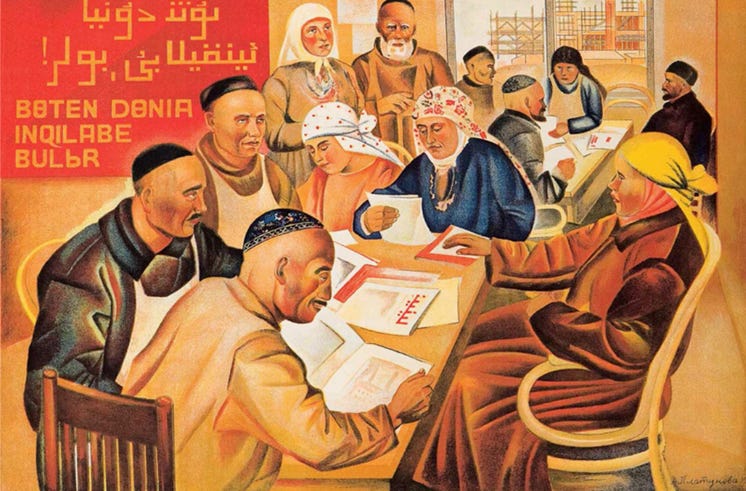
In southern Tajikistan in 2018, a group of Muslim clerics used their congregations’ weekly donations to restore a toppled statue of Vladimir Lenin, returning it to its plinth in the town centre. To many outside observers, this gesture may seem surprising: why would devout Muslims ever take it upon themselves to preserve a monument to a communist leader? After all, religion and communism are often said to be diametrically opposed.
For those puzzled by the actions of the Tajik clerics, this article will hopefully make clear how someone could find meaning in both communism and Islam. It will focus on three areas where the two traditions converge, namely, economics, the question of state power, and world outlook.
It is worth noting that, in this article, communism refers to the thought of Marx, Engels, Lenin, Stalin, and Mao. My understanding of Islam is based primarily on the Quran, the word of God as revealed to the Prophet Muhammad, and the Nahj al-Balagha, a collection of sermons, prayers, and sayings attributed to Imam Ali.
Economics:
Some of the most obvious common ground between Islam and communism can be found in the sphere of economics.
It is useful to begin with Marx’s theory of surplus value, as it forms the foundation of the communist critique of capitalism. The central idea is that a labourer produces the equivalent of their daily wages within only a few hours of work, while the remainder of the working day creates profit for the capitalist. The value produced by the labourer but appropriated by the capitalist is known as “surplus value”, and the appropriation of this surplus value forms the beating heart of the capitalist political economy.
Under capitalism, Marx argued, appropriation is concealed by the monetary form: “The Roman slave was held by fetters: the wage labourer is bound to his owner by invisible threads. The appearance of independence is kept up by means of a constant change of employers, and by the fictio juris of a contract.”[1] So while workers may appear to be fully compensated for their labour under capitalism, the wages they receive are always lower than the value they produce so that the capitalist can extract profit. Wage labour is therefore a system of exploitation, and Marx called not merely to reform this system but to transcend it entirely.
Although Marx was reluctant to write “cookbooks for the future,” he nevertheless offered some indications of how society might develop beyond capitalism in Critique of the Gotha Programme. Marx described communism as a historical process divided into two distinct stages. The lower stage (often referred to as socialism) would retain certain “birthmarks” of capitalism, while the higher stage would constitute a fully developed communist society.
In the lower stage of communism, distribution follows the principle of “to each according to his work.” For example, many workers in the early Soviet Union were paid under a “progressive piece-rate system”, where wages were tied to how much each worker produced above or below the established norm.
Only in the higher stage of communism can the principle “from each according to his ability, to each according to his needs” be fully realised. But that does not mean communism seeks to deny people the fruits of their own labour. As Marx and Engels wrote, “Communism deprives no man of the power to appropriate the products of society; all that it does is deprive him of the power to subjugate the labour of others by means of such appropriations.”[2] Under this principle, people can still enrich themselves through the fruits of their own labour; what they cannot do is enrich themselves through the exploitation of others.
Much like Marxism, Islam forbids building wealth through exploitation rather than hard work. The idea that wealth should be tied to one’s own labour is reflected in the Quranic teachings: “Man shall have nothing but what he endeavours towards”[3] and “Whoever revives dead land, it belongs to him.”[4] Even beyond this, Imam Sadiq confirmed that cultivating land creates a stronger claim to ownership than legal title alone: “Any man who comes to an uncultivated, ruined land, digs its rivers, and cultivates it, must pay alms on it. If the land had belonged to a man before him, but he went away and abandoned it, so that it became ruined, then later came back to claim it, the land belongs to God and to the one who cultivates it.”[5] In Islamic thought, therefore, labour forms the basis of ownership.
Islamic teachings have long held that hard work is the only legitimate means of sustenance. God, for example, described David as an “excellent servant” were it not that he ate from the public treasury rather than working with his “own hands”. God then softened iron for David so that he could forge a coat of mail each day and earn his livelihood independently of the public treasury.[6]
In the same spirit, Imam Sadiq was once asked by a companion on a hot summer’s day: “May I be sacrificed for you. You have a prominent position before God, are closely related to the Messenger of God, and yet you still strive on a day like this?” Imam Sadiq replied: “I came out in search of my sustenance so that I would not need to spread my hands before humankind for help.”[7] Clearly, Islam discourages people from living off the labour of others and encourages them to sustain themselves through their own work. So central is this principle to Islam that the Quran calls on people to reflect continually on the source of their sustenance: “Let man look at his food.”[8]
This principle is also reflected in the Quranic prohibition against riba (or usury). Considered alongside other Quranic teachings – such as the commands to “give full measure” and “not defraud people of their due”[9] – the prohibition against riba extends beyond merely charging interest on loans and encompasses all transactions where capital increases without labour being involved.
Thus, both Islam and Marxism reject the idea that a small elite should be able to live off the labour of others rather than engage in productive work themselves.
State power:
Similarities between Islam and communism can also be seen in how each school of thought understands state power.
From the communist perspective, the state apparatus – including the police, courts and cultural institutions – is monopolised by the capitalist class and functions as a tool for the oppression of working people. The state apparatus is never turned against the elites. The release of the Epstein files, for example, has yet to result in the prosecution of Epstein’s powerful associates. As Marx said: “The state is an organ of class domination, an organ of oppression of one class by another.”[10]
Communists regard the capitalist electoral system as a way of obscuring the reality that the state is dominated by a dictatorship of the elites. As Marx wrote: “The oppressed are allowed once every few years to decide which particular representatives of the oppressing class shall represent and repress them.”[11] No matter who is elected, the capitalist state continues to serve the interests of the elites over those of the workers. The historic aim of communists has always been to “smash” the dictatorship of the elites and replace it with a dictatorship of the working class or, in other words, a people’s democratic dictatorship.
To those unfamiliar with communism, it may seem strange that a dictatorship could also be described as democratic, so it is worth clarifying this point. In Marxist thought, a people’s democratic dictatorship is democratic because it serves the interests of the great majority by enabling workers to establish their own state and elect their own government. At the same time, it is dictatorial because the state suppresses the elites when they act in a self-serving or disturbing manner. Put simply, communists want to establish a state that treats the elites in the same oppressive manner that they have historically always treated working people.
A practical example of a people’s democratic dictatorship was the Soviet Union. The first soviet (or council) was officially established in 1905 to represent textile workers in their struggle against their employers. Soviets soon spread across Russia, becoming a new form of local authority. After the October Revolution, the Bolsheviks decreed that all power across the country would pass into the hands of these soviets.
Deputies to the soviets were elected on the basis of universal suffrage, and anyone over the age of 18 could stand as a candidate.[12] Deputies received instructions from the people, which were compiled into mandates. If the deputies failed to fulfil these instructions, they could be recalled at any time, regardless of rank, by a two-thirds majority of the electorate. The Soviet Union was therefore a form of democracy in which the vast majority of people were empowered, for the first time, to participate in the administration of the state – a democracy where, in the words of Lenin, “every cook must learn to govern.”
In much the same way, Islam advocates a form of state power that draws the masses into the decision-making process in practice, not merely in words.
In the Quran, God instructs the Prophet Muhammad to consult with others before making decisions.[13] Imam Ali insisted that even society’s most marginalised voices should be included in this process of consultation: “No person, however great his status in the sight of God, and however advanced his distinction in religion may be, is above needing assistance with the obligations placed on him by God. And no man, however insignificant in the eyes of others or looked down upon, is too low to offer assistance.”[14]
It is worth mentioning that, throughout Islamic history, important disputes were argued not behind closed doors but before the people themselves. Lady Fatimah, for example, challenged Abu Bakr’s refusal to recognise her claim to the fertile lands of Fadak by bringing her case directly to the people.[15] Imam Ali took a similar approach in his dealings with Talha and Zubayr, the Kharijites, and Muawiyah – presenting the facts to the people, clarifying matters for them, and seeking their verdict. In one letter, Imam Ali even went so far as to identify the voice of the masses as the judgment of God: “Surely, the virtuous are known by the reputation that God circulates for them through the tongues of His creatures.”[16] In this respect, true Islamic leadership should be guided by the views of the great majority of people rather than relying exclusively on the opinions of elites or experts.
Imam Ali embodied the humility expected of Islamic leaders: “Do not abstain from speaking the truth or pointing out a matter of justice, because I do not regard myself as above erring.”[17] As these statements make clear, Islam envisions a relationship between the leadership and the masses that is collaborative rather than mechanical and one-sided. Leaders are not only responsible for teaching the people, but must also learn from them.
Imam Ali’s approach bears a striking resemblance to that of Mao Zedong, who argued: “We should go to the masses and learn from them, synthesise their experience into better, articulated principles and methods, then do propaganda among the masses, and call upon them to put these principles and methods into practice so as to solve their problems and help them achieve liberation and happiness.”[18] Both Islam and communism therefore advocate a form of government where the masses are empowered to participate in the decision-making process.
World outlook:
The communist world outlook is defined by two fundamental theories: dialectics and materialism.
Materialism relates to how matter is interpreted. While idealism treats consciousness as the source of all that exists on earth, materialism recognises that matter exists independently of consciousness. This does not mean to say that materialists deny the active role that consciousness can play in the world, but that we recognise consciousness as operating within limits imposed by matter. For example, revolutions fail when they adopt incorrect plans and succeed when they adopt correct ones. Revolutionary movements must therefore ground themselves in material reality and in the objective laws that govern the world.
From the materialist perspective, man liberates himself through his interactions with the material world, he is not liberated through acts of “divine providence”. While it is therefore difficult to argue that belief in the creation of the world by God is compatible with materialism, it is possible to argue that an idealist outlook towards the world’s creation does not necessarily prevent someone from having a materialist outlook towards social change. In other words, religion does not require believers to passively wait and see what God will do next.
In fact, the Islamic faith constantly reiterates the need for social practise, in clear distinction to purely idealist religions that regard faith a mental exercise empty of any substance. Imam Ali, for example, disapproved of those who claim Islam in word but fail to uphold it in practice, asking: “How is it that his hope does not appear through his actions? For anyone who hopes in something, that hope is known through his actions.”[19] In the economic sphere, the Quran labels those who “repulse the orphan”, “do nothing to encourage the feeding of the poor”, and “refuse to give even the simplest of aid” as unbelievers, regardless of whether they perform prayers.[20] Elsewhere, the Quran condemns those who claim to follow Islam but withhold their wealth, identifying true Muslims as only those who “strive with their wealth and their lives in the cause of God.”[21] It is therefore clear that Islam sees social practice as the ultimate criterion for measuring the authenticity of faith.
It is not unimportant to point out that the prophets, more than anyone else, struggled against the exploiting classes of their time. Muhammad, for example, took real steps to uproot the tribal hierarchies of Mecca and to advance a more equal economic order. Moses also dedicated his life to liberating the oppressed from the tyrannical rule of Pharaoh. Similarly, Jesus devoted himself to defending the most marginalised of Rome and sacrificed his life in the process. Despite their complete trust in God, the prophets understood that certain outcomes could only be achieved through their own effort and action. In this respect, Islam recognises man as the causal agent behind historical developments, and therefore approaches social change in a way that is compatible with a materialist worldview.
Dialectics is the second fundamental feature of the communist world outlook. It is a theory of development that regards nature not as dead and rigid, but as living, changing, and passing through a real history. Marx and Engels admired Darwin because he showed that “the organic world of today, plants and animals, and consequently man too, is all a product of a process of development that has been in progress for millions of years.”[22]
Dialectics explains development in terms of internal contradictions – as “the ‘struggle’ of opposites” to borrow the words of Lenin.[23] For example, in the organic world organisms develop through a cycle of life and death, which is driven forwards by the contradiction between the formation of cells on one hand and their inevitable decay on the other.
Applying the dialectical approach to the social sciences, Marx concluded that human history is driven forwards by the contradiction between two key elements: first, the productive forces (the tools, skills, machinery, technology, and techniques of labour) and second, the relations of production (the social systems man creates to produce and distribute goods). As the productive forces develop, the relations of production become “fetters” upon their further development. At this stage, the class whose interests lie in resolving the contradiction between the forces and relations of production must lead a revolution to reorganise society and free it from these contradictions. Thus, one epoch gives way to another. “The hand-mill gives you society with the feudal lord,” wrote Marx, “the steam-mill gives you society with the industrial capitalist.”[24]
Islamic texts do not present Islam metaphysically, that is, as something one-sided or isolated from other phenomena. Rather, they explain Islam dialectically, in terms of its relationship to other phenomena – to its opposites.
Imam Ali, for example, argued that true Islam could only be revealed through a dialectical approach: by becoming familiar with the forces that stand in opposition to Islam, and recognising that Islam’s authentic message can only be revealed in its struggle against these forces: “You should know that you will never know guidance unless you know who has abandoned it, you will never abide by the pledges of the Qur’an unless you know who has broken them, and you will never cling to it unless you know who has forsaken it.”[25]
In the context of class society, Islam likewise adopts a dialectical approach. By examining the tension between the exploited and exploiting classes, the Quran concludes that the role of the oppressed is one of leadership and guidance: “And We wanted to confer favour upon those who were oppressed in the land and make them leaders and inheritors.”[26] Thus, the exploited class are the force that leads society towards a higher stage of development. With this in mind, it is unsurprising that the prophets not only engaged in social action but also aligned themselves with the oppressed classes of their time. The Quran describes how the elites denigrated the followers of the Prophet Noah as the “lowliest of people”,[27] and how the message of the Prophet Salih resonated with the “lowly believers” while being disdained by the “arrogant chiefs”.[28] The prophets therefore embraced the exploited classes as the force capable of leading human society toward higher and more harmonious stages of development.
Conclusion:
This article has hopefully shown that communism and Islam are not as contradictory as is often assumed. In fact, on many fundamental questions the two schools of thought reach similar conclusions. It is perhaps for this reason that the Tajik clerics saw no contradiction between their faith and their admiration of Lenin.
Yet common ground exists not only in theory, but also in historical experiences. Both Islam and communism have been subject to relentless distortions, abuses, and misinterpretations with the purpose of obscuring their revolutionary content and rendering them politically harmless.
In the Muslim world, many leaders stand idly by while Israel carries out a genocide in Palestine. Ali Larijani, secretary of Iran’s Supreme National Security Council, condemned Islamic governments that, “except for rare cases”, failed to stand beside the Iranian people in their revolutionary struggle against Israel. Larijani asked: “What kind of Islam is this? Which side do you stand on?”
As many leaders of the Muslim world have endeavoured to strip Islam of its revolutionary content and transform it into an individualistic identity, Communism has undergone a comparable transformation. In many cases, those claiming communism’s mantle have reduced what was once a mass movement dedicated to uplifting the working-class into a subculture centred around “alternative lifestyles”.
But neither Islam nor communism will be defeated by these distortions. Both traditions possess such a wealth of history and richness of content to be reduced to falsifications. Thus, communism and Islam are capable of resisting these distortions and, in time, overcoming them.
[1] Marx, Capital Vol. 1
[2] Marx and Engels, Communist Manifesto
[3] Surah An-Najm, 53:39
[4] Irwa al-Ghalil, 1550; al-Tirmidhi, 1379; Ibn Ḥibban, 1139
[5] Furu al-Kafi, vol. 5
[6] Furu al-Kafi, vol. 5
[7] Furu al-Kafi, vol. 5
[8] Surah Abasa, 80:24
[9] Surah Hud, 11:85
[10] Marx quoted in Lenin, The State and Revolution
[11] Marx quoted in Lenin, The State and Revolution
[12] Although before 1936 voting took place by show of hands and some exclusions had been made towards those who lived on unearned income.
[13] Surah Al-Imran, 3:159
[14] Nahj al-Balagha, 216
[15] The Sermon of Fadak
[16] Nahj al-Balagha, letter 53
[17] Nahj al-Balagha, 214
[18] Mao, Get Organized!
[19] Nahj al-Balagha, 158
[20] Surah al-Ma’un, 107
[21] Surah Al-Hujurat, 49:15
[22] Engels quoted in Stalin, Dialectical and Historical Materialism
[23] Lenin, On the Question of Dialectics
[24] Marx, The Poverty of Philosophy
[25] Nahj al-Balagha, 147
[26] Surah Al-Qasas, 28:5
[27] Surah Hud, 11:27; see also Surah ash-Shu’ara, 26:111
[28] Surah al-A’raf, 7:75-76
This is interesting precisely because it avoids the shallow “religion vs communism” framing that dominates so much discussion. The strongest sections are the ones grounding the comparison in material questions - labour, property, exploitation, and state power - rather than abstract moral similarities. The argument becomes especially persuasive when showing how both traditions historically aligned themselves with the oppressed against entrenched hierarchies.
I also think the article is strongest when it treats both Islam and communism as living historical traditions shaped through struggle rather than static doctrines frozen in texts. The discussion of social practice, consultation, and class conflict gives the piece much more substance than the usual attempts to force superficial parallels between religion and socialism.
At the same time, there are still real tensions that probably deserve deeper exploration, especially around metaphysics, secularism, and the role of religious authority within revolutionary movements. But the core point stands: the relationship between Islam and communism has historically been far more complex than the Cold War caricature of automatic hostility. A fascinating piece!